Simple Distillation
GCSE Chemistry
Middle School Science
Key Stage 3
Make it your own
Load this set up into Chemix to make changes and export your diagram.
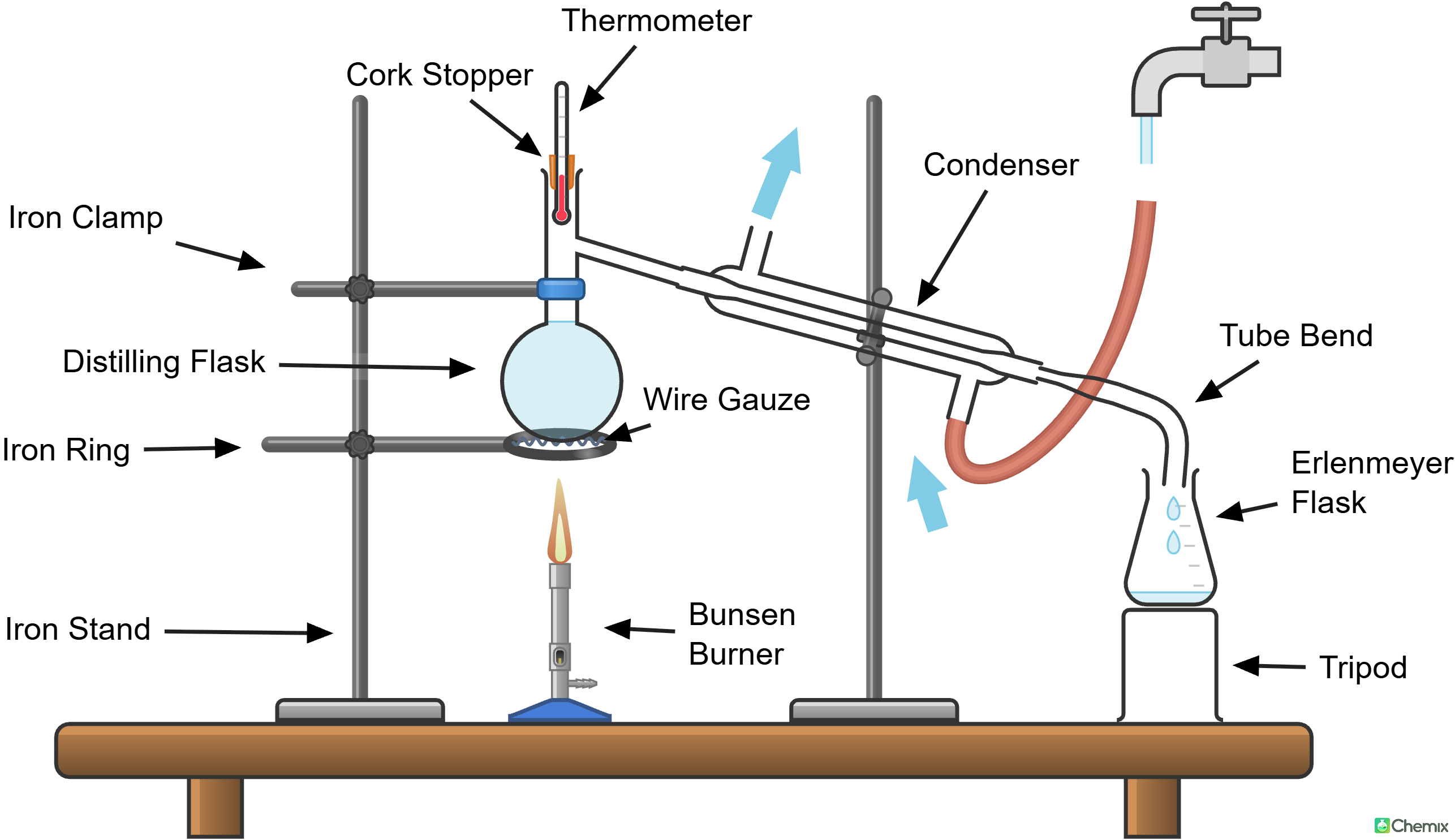
Edit in ChemixIllustrates the simple distillation process used to purify a liquid or separate a volatile solvent from dissolved non-volatile solutes (or from another liquid when their boiling points differ significantly, typically by more than 25 °C). The solution is heated until the solvent vaporises, and the vapour is cooled in a water-jacketed Liebig condenser so it condenses back into a pure liquid distillate.
Common classroom experiments and real-world applications include:
- Purifying water from saltwater (desalination of seawater to produce pure distilled water)
- Separating water from ink or food colouring solutions in introductory chemistry lessons
- Producing laboratory-grade distilled water for chemical reagents, car batteries, and steam irons where dissolved minerals must be removed
- Recovering volatile organic solvents from dissolved solid residues after a chemical reaction