
Polystyrene Cup Calorimetry
GCSE
IGCSE
A-Level
High School
AP
IB
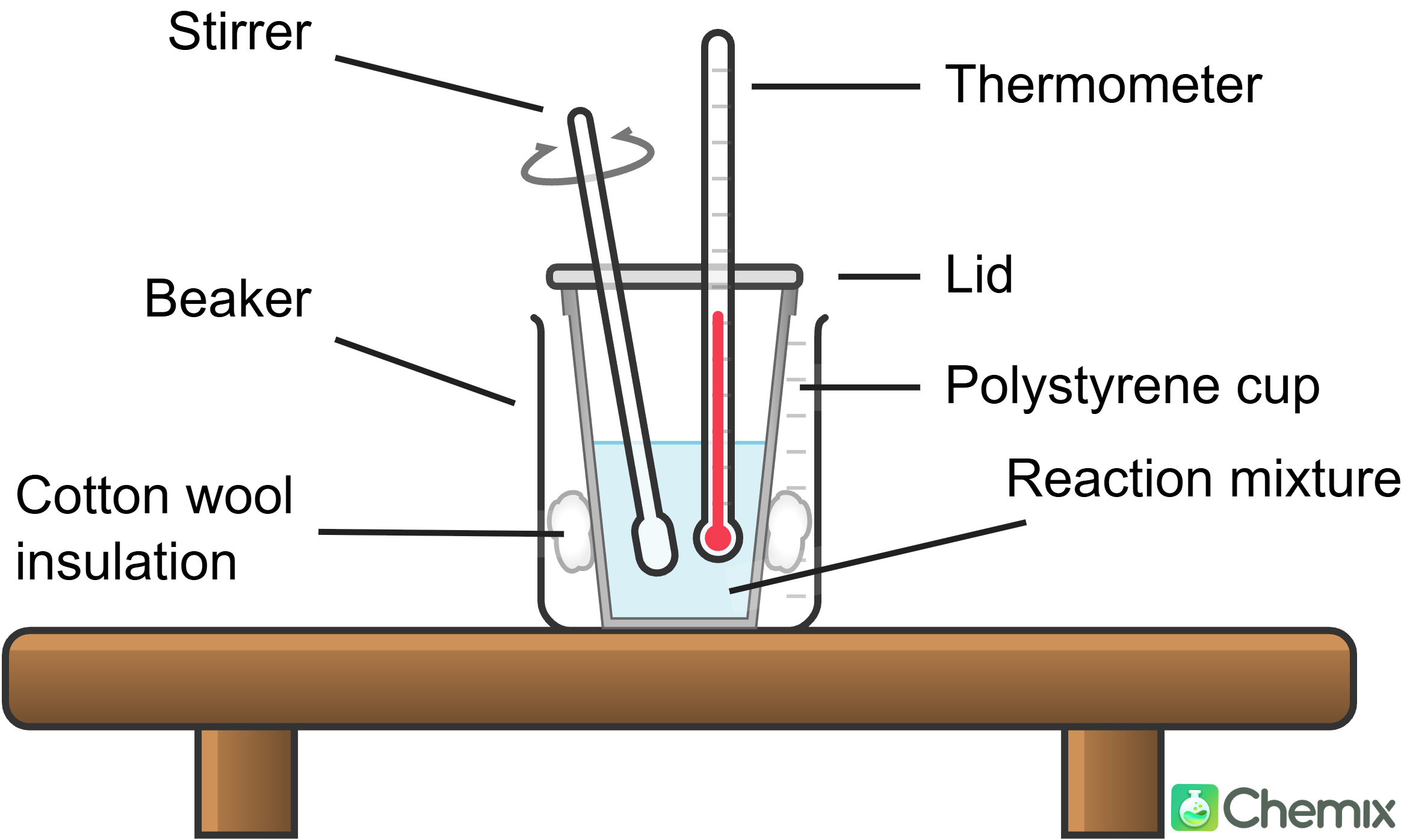
Make it your own
Load this set up into Chemix to make changes and export your diagram.
Edit in ChemixConstant-pressure calorimetry technique used to measure the temperature change (ΔT) of reactions occurring in aqueous solution and determine the enthalpy change (ΔH). Because expanded polystyrene is a thermal insulator with negligible heat capacity, carrying out the reaction in a lidded polystyrene cup minimises heat exchange with the surroundings so the thermal energy released (exothermic) or absorbed (endothermic) is transferred almost entirely to the solution (q = mcΔT).
Common classroom experiments and real-world applications include:
- Determining the enthalpy change of neutralisation by reacting strong acids and alkalis such as hydrochloric acid and sodium hydroxide
- Measuring the enthalpy change of displacement when a more reactive metal such as zinc or magnesium powder is added to aqueous copper(II) sulfate
- Investigating the enthalpy change of solution by dissolving ionic salts such as ammonium chloride, potassium nitrate, or anhydrous copper(II) sulfate in water
- Evaluating chemical hand warmers and instant cold packs, which rely on exothermic oxidation/crystallisation or endothermic dissolution of salts such as ammonium nitrate