
All Experiment Templates
Showing 6 templates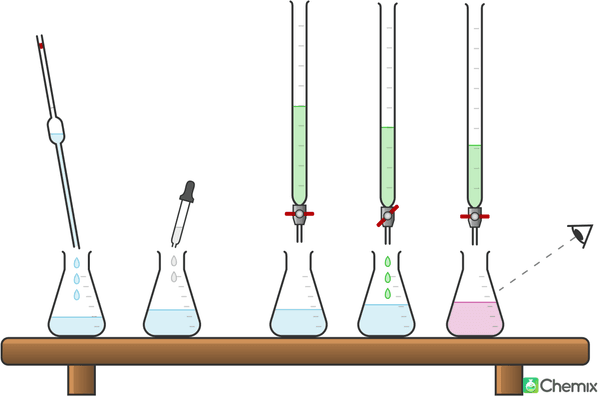
Acid-Base Titration
Volumetric analysis technique used to determine the exact concentration of an unknown acid or alkali solution through neutralisation. A standard solution (titrant) of known concentration is gradually added from a burette to a measured volume of the analyte until the endpoint is reached, signalled by a sharp colour change of a pH indicator such as phenolphthalein or methyl orange. Common classroom experiments and real-world applications include: Standardising strong acid and alkali solutions (such as hydrochloric acid and sodium hydroxide) in school and university practicals Determining the ethanoic acid content in vinegar or citric acid concentration in fruit juices for food quality control Analysing the purity of pharmaceutical tablets, such as measuring the active acetylsalicylic acid in aspirin or neutralising capacity of antacid tablets Monitoring water quality and alkalinity in environmental testing and municipal water treatment
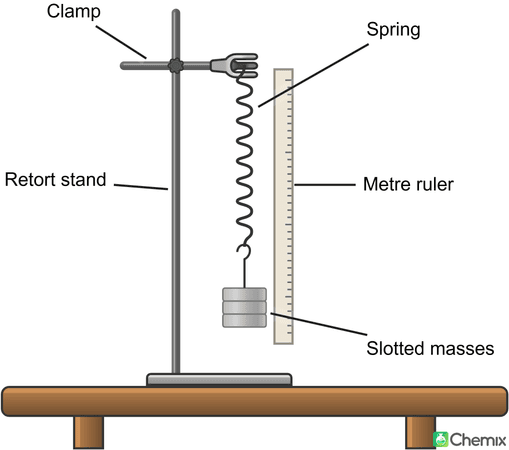
Hooke's Law & Spring Extension
Investigate the relationship between the applied load (force) and the resulting extension of an elastic material such as a helical spring. By adding known masses incrementally and measuring the change in length from the spring's unloaded equilibrium position, students verify Hooke's Law (F = ke)—the extension is directly proportional to the applied force up to the limit of proportionality, and the gradient of the force–extension graph gives the spring constant (k). Common classroom experiments and real-world applications include: Determining the spring constant (k) of steel springs or comparing springs connected in series and parallel Investigating elastic vs. plastic deformation by loading a spring or copper wire past its elastic limit to observe permanent extension Calibrating a newtonmeter (spring balance) using known standard masses to measure unknown forces or weights Designing suspension systems, shock absorbers, and mechanical scales in engineering, where predictable elastic deformation is required
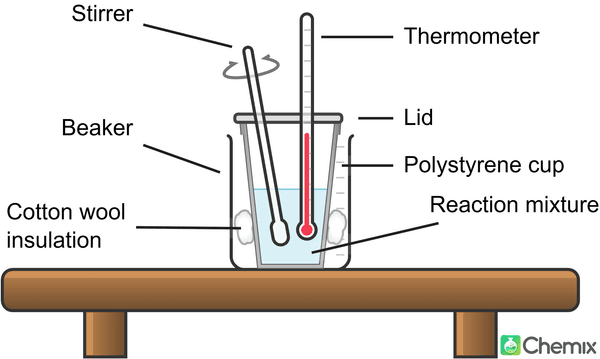
Polystyrene Cup Calorimetry
Constant-pressure calorimetry technique used to measure the temperature change (ΔT) of reactions occurring in aqueous solution and determine the enthalpy change (ΔH). Because expanded polystyrene is a thermal insulator with negligible heat capacity, carrying out the reaction in a lidded polystyrene cup minimises heat exchange with the surroundings so the thermal energy released (exothermic) or absorbed (endothermic) is transferred almost entirely to the solution (q = mcΔT). Common classroom experiments and real-world applications include: Determining the enthalpy change of neutralisation by reacting strong acids and alkalis such as hydrochloric acid and sodium hydroxide Measuring the enthalpy change of displacement when a more reactive metal such as zinc or magnesium powder is added to aqueous copper(II) sulfate Investigating the enthalpy change of solution by dissolving ionic salts such as ammonium chloride, potassium nitrate, or anhydrous copper(II) sulfate in water Evaluating chemical hand warmers and instant cold packs, which rely on exothermic oxidation/crystallisation or endothermic dissolution of salts such as ammonium nitrate
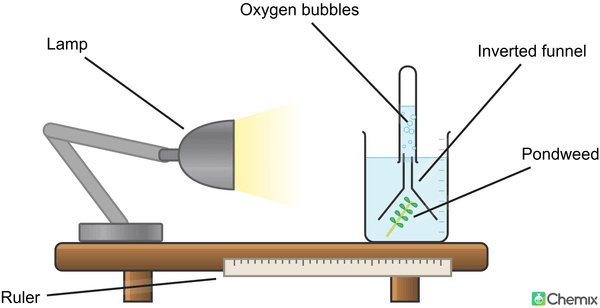
Rate of Photosynthesis (Pondweed & Light Intensity)
Quantify how light intensity affects the net rate of photosynthesis in submerged pondweed (Elodea or Cabomba) by measuring oxygen evolution. During the light-dependent reactions, the photolysis of water produces oxygen gas, which escapes from the cut stem as visible bubbles and collects in an inverted water-filled tube. By controlling temperature and carbon dioxide availability (typically with sodium hydrogen carbonate), the setup isolates light intensity as the limiting factor. Common classroom experiments and real-world applications include: Measuring how light intensity affects photosynthetic rate by recording bubble frequency or gas volume at incremental distances from a lamp Comparing the action spectrum of photosynthetic pigments by illuminating the plant with different wavelengths of light Determining the light compensation point, where photosynthetic oxygen production balances respiratory oxygen uptake Assessing primary productivity and oxygenation in aquatic ecosystems and commercial aquaculture systems
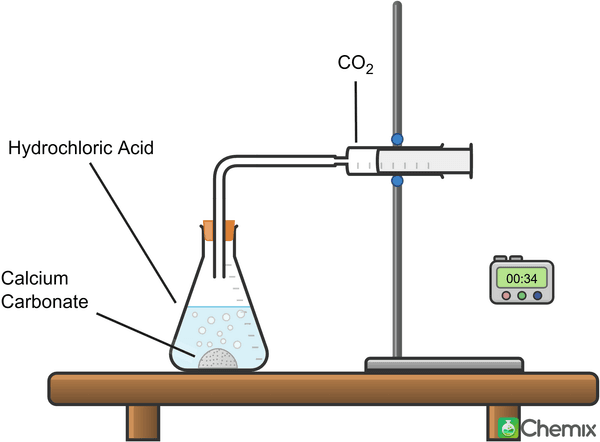
Rates of Reaction (Gas Syringe)
Measure the rate of a chemical reaction that produces a gas by recording the volume of gas collected in a gas syringe at regular time intervals. Because the syringe is a closed system with low friction, it provides precise volume measurements for both soluble and insoluble gases, allowing students to compare reaction rates across different experimental conditions such as reactant concentration, particle size, temperature, or presence of a catalyst. Common classroom experiments and real-world applications include: Reacting calcium carbonate (powder vs. marble chips) with hydrochloric acid to measure carbon dioxide evolution and investigate how surface area or concentration alters the rate of reaction Decomposing hydrogen peroxide with a manganese(IV) oxide catalyst to measure the rate of oxygen production Reacting magnesium or zinc with dilute hydrochloric or sulfuric acid to track hydrogen gas evolution and determine the order of reaction Assaying the purity of solid carbonates or reactive metals by measuring the final volume of gas evolved at room temperature and pressure (RTP)
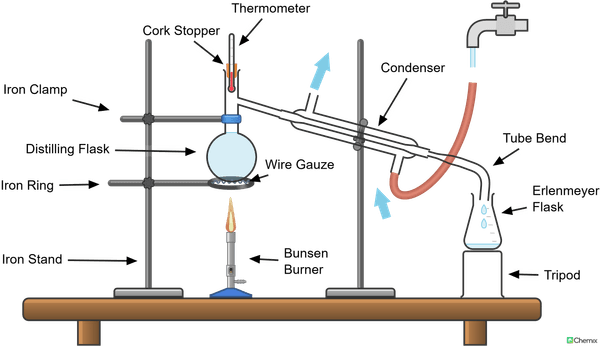
Simple Distillation
Purify a liquid or separate a volatile solvent from dissolved non-volatile solutes (or from another liquid when their boiling points differ significantly, typically by more than 25 °C). The solution is heated until the solvent vaporises, and the vapour is cooled in a water-jacketed Liebig condenser so it condenses back into a pure liquid distillate. Common classroom experiments and real-world applications include: Purifying water from saltwater (desalination of seawater to produce pure distilled water) Separating water from ink or food colouring solutions in introductory chemistry lessons Producing laboratory-grade distilled water for chemical reagents, car batteries, and steam irons where dissolved minerals must be removed Recovering volatile organic solvents from dissolved solid residues after a chemical reaction
No templates match your search
Try clearing your filter or searching for a different experiment name.